
Artificial Intelligence
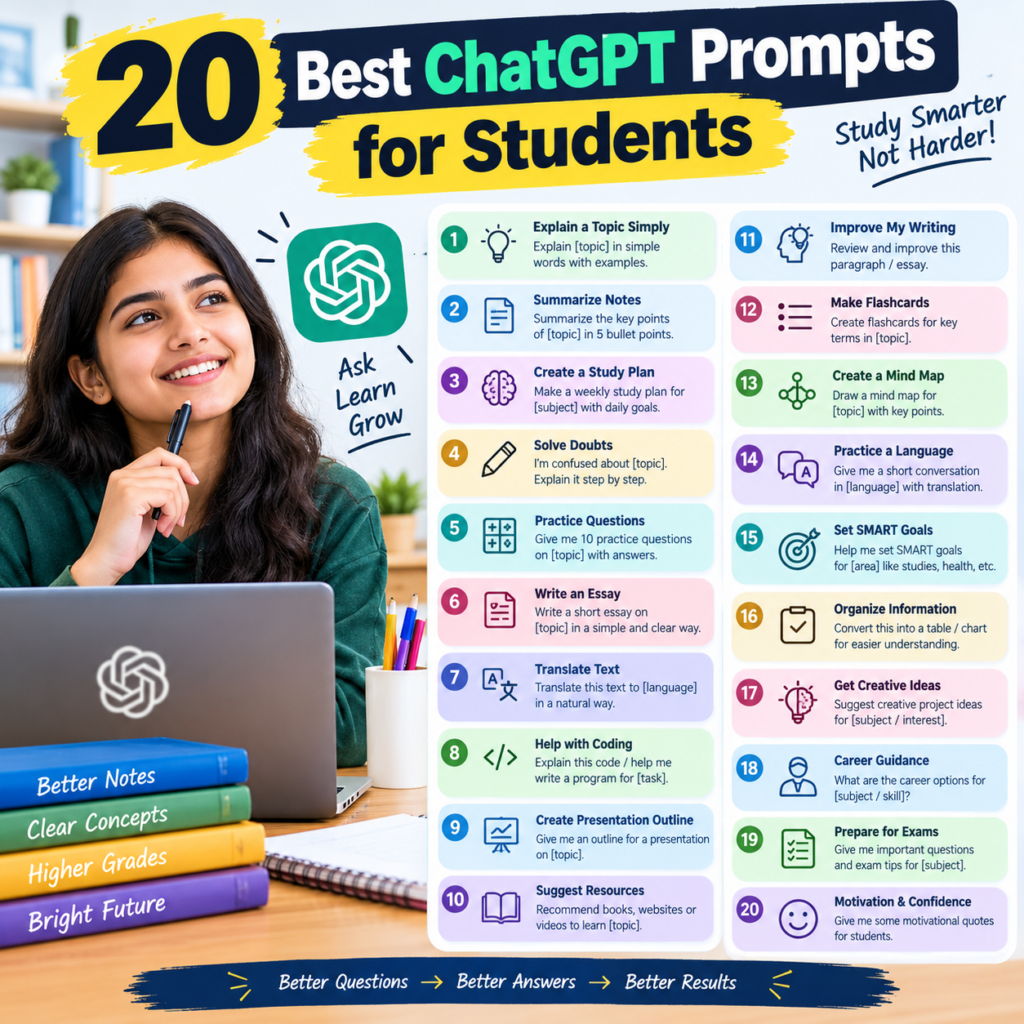
20 Best ChatGPT Prompts for Students
Aug
Artificial intelligence has become a powerful learning companion for students. Among the many AI tools available today, ChatGPT can help students understand difficult concepts, organize their studies, brainstorm ideas, practice questions, improve writing, and prepare for exams.
The key to getting useful results is knowing what to ask. A vague question often produces a generic answer, while a well-written prompt can turn ChatGPT into a personalized tutor, study planner, writing assistant, or exam-preparation partner.
In this guide, you’ll find 20 useful ChatGPT prompts for students that can be adapted for school, college, university, and professional studies.
Tip: Replace the information inside
[brackets]with your own subject, topic, grade, or requirements.
1. Explain a Difficult Topic Simply
When a topic seems complicated, ask ChatGPT to explain it at your current level.
Prompt:
Explain [topic] in simple language as if you were teaching it to a [grade/class/year] student. Use everyday examples and avoid unnecessary technical jargon.
Example:
Explain quantum mechanics in simple language as if you were teaching it to a high school student. Use everyday examples.
This is particularly useful when you’re learning a topic for the first time.
2. Create a Study Plan
A structured study plan can make exam preparation much easier.
Prompt:
Create a [7/14/30]-day study plan for [subject]. I can study for [X] hours per day. Include the topics I should cover each day, revision sessions, practice questions, and rest periods.
You can make the prompt more useful by providing your exam date and the topics included in your syllabus.
3. Summarize a Chapter
Long chapters can be difficult to review before an exam.
Prompt:
Summarize the following chapter into clear and easy-to-understand notes. Include the main concepts, important definitions, key facts, examples, and points that are likely to be important for an exam: [paste text].
This can help you create quick revision notes from your own study material.
4. Generate Practice Questions
Practice is one of the best ways to test whether you’ve actually understood a topic.
Prompt:
Create 20 practice questions on [topic] for a [grade/college level] student. Include a mixture of easy, medium, and difficult questions. Do not provide the answers initially.
After completing the questions, you can ask ChatGPT to provide explanations for the answers.
5. Create a Mock Test
You can use ChatGPT to simulate an examination.
Prompt:
Create a mock test for [subject] based on these topics: [list topics]. Include [number] multiple-choice questions, [number] short-answer questions, and [number] long-answer questions. Make the difficulty similar to a real exam.
You can also specify the exam duration and marks distribution.
6. Act as a Personal Tutor
Instead of asking ChatGPT to give you the answer immediately, turn it into an interactive tutor.
Prompt:
Act as my personal tutor for [subject]. Teach me one concept at a time. Ask me questions to check my understanding before moving to the next concept. If I make a mistake, explain it clearly and give me another example.
This approach encourages active learning rather than simply reading answers.
7. Find the Mistakes in My Answer
ChatGPT can help you identify areas where your answer needs improvement.
Prompt:
Review my answer below as a teacher. Identify factual errors, missing information, unclear explanations, and grammar problems. Explain how I can improve it without completely rewriting it for me.
Then paste your answer.
This is particularly helpful when preparing assignments or practicing exam answers.
8. Turn Notes into Flashcards
Flashcards are useful for memorizing definitions, formulas, dates, vocabulary, and key concepts.
Prompt:
Convert these study notes into 20 flashcards. Put the question on one side and the answer on the other. Focus on important concepts and information that I need to remember for an exam.
You can also ask for the flashcards in a table format.
9. Learn a Topic Through Examples
Some concepts become easier when you see practical examples.
Prompt:
Explain [topic] using five practical, real-world examples. Start with a very simple example and gradually increase the difficulty. Explain what each example demonstrates.
This is useful for subjects such as mathematics, economics, science, programming, and business.
10. Get Help With an Essay Structure
If you have to write an essay, ChatGPT can help you organize your ideas.
Prompt:
Help me create an outline for an essay about [topic]. Include an introduction, main arguments, supporting points, counterarguments, and conclusion. Do not write the complete essay.
Creating the structure first can make the actual writing process much easier.
11. Improve My Grammar
Students can use ChatGPT to identify grammatical mistakes and improve clarity.
Prompt:
Check the grammar, spelling, punctuation, and clarity of the following text. Explain the important mistakes and suggest improvements while keeping my original meaning and writing style.
Paste your paragraph or assignment after the prompt.
12. Explain a Mathematical Problem Step by Step
Instead of asking only for the final answer, ask for the reasoning.
Prompt:
Solve the following problem step by step. Explain the reasoning behind every step and show the formula used. After solving it, give me a similar problem to solve myself: [problem].
This can turn a single question into a learning exercise.
Important: Always verify mathematical answers, especially when using AI for important academic work.
13. Learn Programming With ChatGPT
ChatGPT can act as a programming practice partner.
Prompt:
Teach me [programming language] from beginner to intermediate level. Create a structured learning path with concepts, examples, exercises, and small projects. Do not give me the solution to an exercise unless I ask for it.
You can also ask it to explain errors in your code rather than simply fixing them.
14. Create a Vocabulary Learning Plan
Students learning a new language can use ChatGPT to build vocabulary.
Prompt:
Create a 30-day vocabulary learning plan for [language]. Give me 10 useful words per day with their meanings, pronunciation guidance, example sentences, and a short quiz.
You can adjust the difficulty based on your current language level.
15. Prepare for an Oral Exam
ChatGPT can simulate an interviewer or examiner.
Prompt:
Act as an examiner for my [subject] oral exam. Ask me one question at a time. Wait for my answer, evaluate it, explain what I got right or wrong, and then ask the next question.
This is a useful way to practice explaining concepts without relying on prepared notes.
16. Create a Revision Checklist
A checklist can help you identify what you have and haven’t studied.
Prompt:
Create a comprehensive revision checklist for [subject] based on these topics: [topics]. Divide it into concepts to understand, formulas to memorize, questions to practice, and topics to revise.
You can check off each item as you complete it.
17. Understand the Difference Between Two Concepts
Comparing similar concepts can make confusing topics easier to understand.
Prompt:
Explain the differences between [concept A] and [concept B]. Create a comparison table covering their definitions, key characteristics, advantages, disadvantages, examples, and practical applications.
This works especially well for subjects where concepts are easily confused.
18. Turn a Topic Into a Quiz
Quizzes make revision more interactive.
Prompt:
Create a 15-question quiz about [topic]. Ask me one question at a time and wait for my answer. Tell me whether my answer is correct, explain the answer, keep my score, and give me a final result at the end.
You can ask for multiple-choice, true/false, or short-answer questions.
19. Create a Last-Minute Revision Plan
When an exam is approaching, you may need to prioritize the most important topics.
Prompt:
I have [X] hours/days before my [subject] exam. These are the topics in my syllabus: [topics]. Create a high-priority revision plan. Focus on important concepts, formulas, definitions, common question types, and topics I should practice first.
Don’t rely solely on AI to predict what will appear in an exam. Your syllabus, textbook, teacher’s guidance, and previous examination papers should remain your primary sources.
20. Build a Personalized Learning System
For students who want to use ChatGPT regularly, this prompt can create a complete learning workflow.
Prompt:
Act as my personal study assistant. I am studying [course/subject] at [level]. My goals are [goals]. I can study for [X] hours per day. Help me create a weekly learning plan. For each topic, teach me the concept, ask questions to test my understanding, provide practice exercises, review my answers, and identify areas that need more revision.
This can turn ChatGPT into a flexible study companion rather than just a question-answering tool.
How to Write Better ChatGPT Prompts for Studying
The quality of the response often depends on how much useful context you provide.
Instead of asking:
Explain economics.
Try:
Explain inflation to a first-year college student using simple language, three real-world examples, and a short quiz at the end.
A good student prompt usually includes four things:
1. Give ChatGPT a Role
Tell it what kind of assistance you want.
Examples:
- “Act as my mathematics tutor.”
- “Act as an exam coach.”
- “Act as a programming mentor.”
- “Act as a writing tutor.”
2. Specify Your Level
Tell ChatGPT whether you’re in school, college, university, or learning independently.
For example:
Explain this at a beginner level.
or:
Explain this at an undergraduate level.
3. Describe the Desired Output
Tell it exactly how you want the information presented.
For example:
Use bullet points and examples.
Create a comparison table.
Ask me questions one at a time.
Explain each step.
4. Provide Context
The more relevant information you provide, the more useful the response can be.
For example, include your syllabus, assignment requirements, exam date, topic list, or your own attempt at solving a problem.
How Students Should Use ChatGPT Responsibly
ChatGPT can be a valuable learning tool, but students should use it to learn rather than simply copy.
Here are some good practices:
- Use AI to understand difficult concepts.
- Ask for explanations rather than just final answers.
- Verify important facts using textbooks, academic sources, and teachers.
- Use your own words when writing assignments.
- Check your school’s or university’s AI policy before using ChatGPT for assessed work.
- Don’t submit AI-generated work as your own when academic rules prohibit it.
- Review AI-generated information because AI can sometimes make mistakes.
- Use practice questions and quizzes to test your actual understanding.
One of the most effective approaches is to attempt a problem yourself first and then use ChatGPT to review your reasoning.
Final Thoughts
ChatGPT can be much more than a tool for getting quick answers. When used properly, it can help students understand difficult subjects, practice concepts, organize their studies, improve writing, prepare for exams, and develop better learning habits.
The most effective prompts provide context, specify the student’s level, and explain what kind of response is required.
Start with the prompts above and customize them for your own subjects and learning goals. Over time, you’ll discover which prompt styles work best for you.
Remember: AI should support your learning, not replace it. The goal is not simply to get the right answer—it is to understand why the answer is right.
