
World News
BRICS Summit 2026: Key Highlights, India’s Role and What It Means for the World
Sep
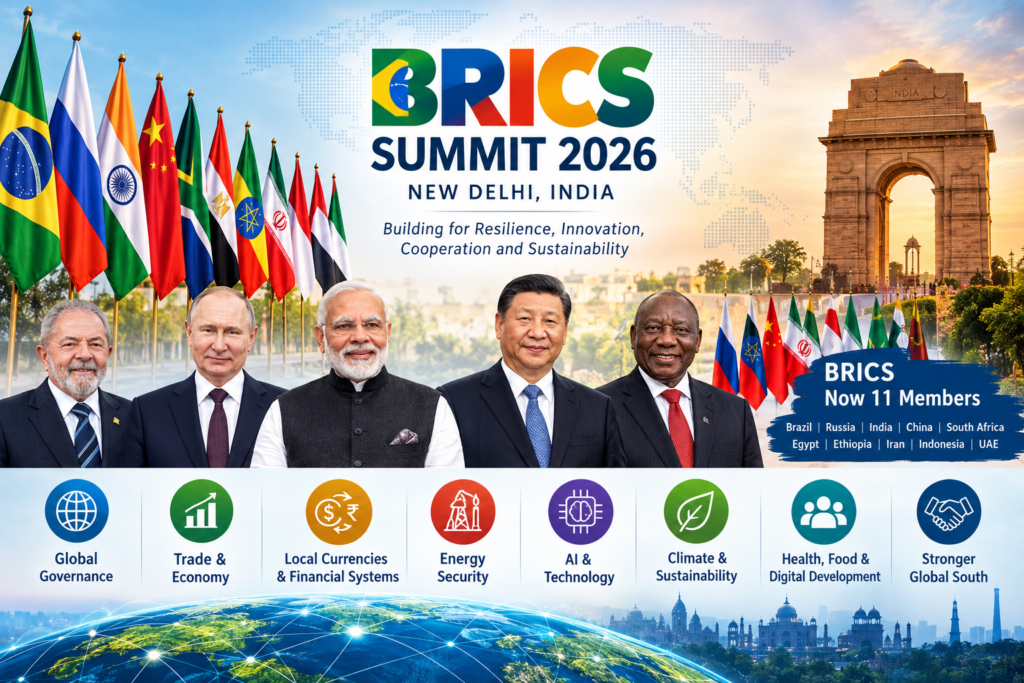
The BRICS Summit 2026 has brought some of the world’s most influential emerging economies together at a time of major geopolitical and economic uncertainty. Hosted by India in New Delhi on September 12–13, 2026, the 18th BRICS Summit focused on economic cooperation, global governance, technology, energy security, trade, sustainability and the changing balance of power in the world.
The summit was particularly significant because BRICS has expanded considerably in recent years. The grouping now includes 11 member countries, giving it a much larger economic and geopolitical footprint than when it was originally formed.
What Is BRICS?
BRICS originally brought together Brazil, Russia, India, China and South Africa. The name BRICS comes from the initials of these five countries.
The group was created to strengthen cooperation among major emerging economies and to give developing countries a stronger voice in global institutions.
BRICS cooperation broadly covers three major areas:
- Political and security cooperation
- Economic and financial cooperation
- Cultural and people-to-people exchanges
India’s Ministry of External Affairs describes these as the three fundamental pillars of BRICS cooperation.
The grouping has since expanded, with Egypt, Ethiopia, Iran, Indonesia and the United Arab Emirates joining as members. This expansion has significantly increased BRICS’ representation across Asia, Africa and the Middle East.
BRICS Summit 2026: Why Was It Important?
The 2026 summit took place against a backdrop of wars, trade tensions, energy-market disruptions and growing competition between major powers.
One of the biggest challenges was the ongoing conflict involving Iran and the wider Middle East. Energy markets have been particularly sensitive to geopolitical developments, making oil supplies and global trade routes important issues for BRICS countries.
The summit therefore became more than an economic meeting. It was also an important diplomatic gathering involving leaders such as Indian Prime Minister Narendra Modi, Chinese President Xi Jinping and Russian President Vladimir Putin.
Major Issues Discussed at the Summit
1. Reform of Global Institutions
One of BRICS’ long-standing objectives is to push for a more representative international system.
BRICS members have argued that institutions created decades ago do not fully reflect the economic and political importance of developing countries today.
The group continues to support greater representation for developing economies in institutions such as the United Nations and international financial organizations.
The 2026 summit again emphasized the importance of strengthening multilateralism and giving the Global South a greater voice in international decision-making.
2. Trade and Local Currencies
Reducing dependence on traditional international payment systems has remained an important topic within BRICS.
However, the idea of creating a common BRICS currency should not be confused with the group’s actual policy. India has indicated that there is currently no proposal for a common BRICS currency, while discussions have focused more on increasing the use of local currencies for bilateral trade.
Greater use of local currencies could potentially reduce foreign-exchange costs and make trade between participating countries more flexible.
3. Energy Security
Energy security was another major issue.
BRICS countries include some of the world’s largest producers and consumers of oil, gas and other energy resources. Any disruption to major shipping routes can therefore have consequences for inflation, transportation costs and economic growth.
With global oil markets facing geopolitical risks, cooperation on energy security has become increasingly important.
For countries such as India, stable and affordable energy supplies are particularly important because higher crude oil prices can increase fuel costs and contribute to inflation.
4. Artificial Intelligence and Technology
Technology has become an increasingly important part of the BRICS agenda.
The 2026 summit placed significant attention on innovation and artificial intelligence. China proposed initiatives including a BRICS AI Open Source Zone, with the broader goal of increasing technological cooperation among member countries.
Artificial intelligence could become an important area of cooperation involving:
- AI research
- Open-source technology
- Digital infrastructure
- Data and computing
- AI skills and education
- Responsible AI development
For emerging economies, cooperation in these areas could help reduce technological dependence and accelerate digital transformation.
India-China Relations Take Centre Stage
One of the most closely watched developments around the summit was the meeting between Prime Minister Narendra Modi and Chinese President Xi Jinping.
Xi’s visit was significant because it marked his first trip to India since 2019. The two leaders held bilateral discussions covering relations between the two countries, including border issues and economic cooperation.
The meeting demonstrated an important feature of BRICS: countries can cooperate through a multilateral platform even when they have serious bilateral disagreements.
For India, maintaining dialogue with China while protecting its strategic and economic interests remains an important foreign-policy challenge.
India-Russia Relations
Russian President Vladimir Putin was also a major participant at the summit.
India and Russia have maintained close strategic and economic relations for decades, particularly in areas such as energy, defence and trade.
The BRICS meeting provided another opportunity for the two countries to discuss bilateral economic cooperation as well as major international conflicts.
India has consistently advocated dialogue and diplomacy as the preferred approach to resolving international conflicts.
BRICS and the Global South
One of the biggest strategic themes behind BRICS is the growing influence of the Global South.
Developing countries increasingly want greater influence over decisions involving international finance, trade, climate policy, technology and development.
BRICS provides a platform through which emerging economies can coordinate their positions and negotiate with larger developed economies.
The expansion of BRICS has made this platform even more significant.
New Delhi Declaration
A major outcome of the summit was the New Delhi Declaration, which set out the group’s shared positions on international and economic issues.
The declaration addressed subjects including terrorism, global conflicts, trade, energy, climate change and reform of international institutions. It also emphasized cooperation on economic development, digital agriculture, health, infrastructure, MSMEs and youth skills.
The declaration is important because it demonstrates the group’s attempt to maintain a common position despite significant differences among its members.
What Does BRICS Mean for India?
The summit is particularly important for India because the country is one of the founding members and held the BRICS chairship in 2026.
India assumed the chairship on January 1, 2026, and organized more than 350 meetings and high-level engagements across more than 25 Indian cities during its chairship.
For India, BRICS provides several potential advantages:
Economic opportunities: Greater trade and investment cooperation could create opportunities for Indian businesses.
Energy security: Stronger relationships with major energy-producing countries can support India’s energy needs.
Technology: Cooperation in AI, digital infrastructure and innovation could benefit India’s technology ecosystem.
Diplomatic influence: BRICS gives India another major platform through which it can engage with China, Russia, Brazil, South Africa and other emerging economies.
Global South leadership: India can use BRICS to promote the interests of developing countries while maintaining relationships with Western economies.
Will BRICS Replace the Dollar?
This is one of the most common questions surrounding BRICS.
The short answer is not immediately.
Although BRICS countries are exploring greater use of local currencies in trade and discussing alternatives that could reduce dependence on existing financial systems, there is no immediate common BRICS currency replacing the US dollar.
The dollar remains deeply embedded in global trade, financial markets and international reserves.
A more realistic development is gradual diversification, with some BRICS countries conducting a greater proportion of bilateral trade in their own currencies.
Why BRICS Matters for the Global Economy
The importance of BRICS extends beyond its member countries.
The expanded group represents a substantial share of the world’s population and economic activity. Its decisions can therefore influence global trade, energy markets, investment flows and geopolitical relationships.
If BRICS members successfully increase cooperation in areas such as payments, technology, infrastructure, energy and trade, the group could become an increasingly important economic bloc.
However, challenges remain.
BRICS members have different political systems, economic structures and foreign-policy priorities. India and China have unresolved border issues, while geopolitical conflicts can also create disagreements among members.
Maintaining consensus will therefore be one of the group’s biggest challenges.
What Happens Next?
The future of BRICS will depend on whether the organization can turn declarations into practical cooperation.
Areas such as local-currency trade, AI, startup investment, supply-chain resilience, energy security and infrastructure could provide tangible opportunities for members.
The next stage will be to determine whether BRICS can build institutions and mechanisms that deliver measurable economic benefits rather than simply producing political declarations.
China is set to host the next BRICS summit after India’s 2026 presidency.
Final Thoughts
The BRICS Summit 2026 in New Delhi was an important moment in the evolution of the global economic and political order.
The summit demonstrated that BRICS is no longer simply a grouping of five emerging economies. With its expanded membership, the organization has become a broader platform connecting major economies across Asia, Africa, the Middle East and Latin America.
For India, the summit offered an opportunity to strengthen economic partnerships, promote the interests of the Global South and maintain dialogue with major powers such as China and Russia.
The biggest question now is whether BRICS can convert its growing influence into practical results in trade, finance, technology, energy and global governance.
If it succeeds, BRICS could play an increasingly important role in shaping the next phase of the global economy.
