
Finance
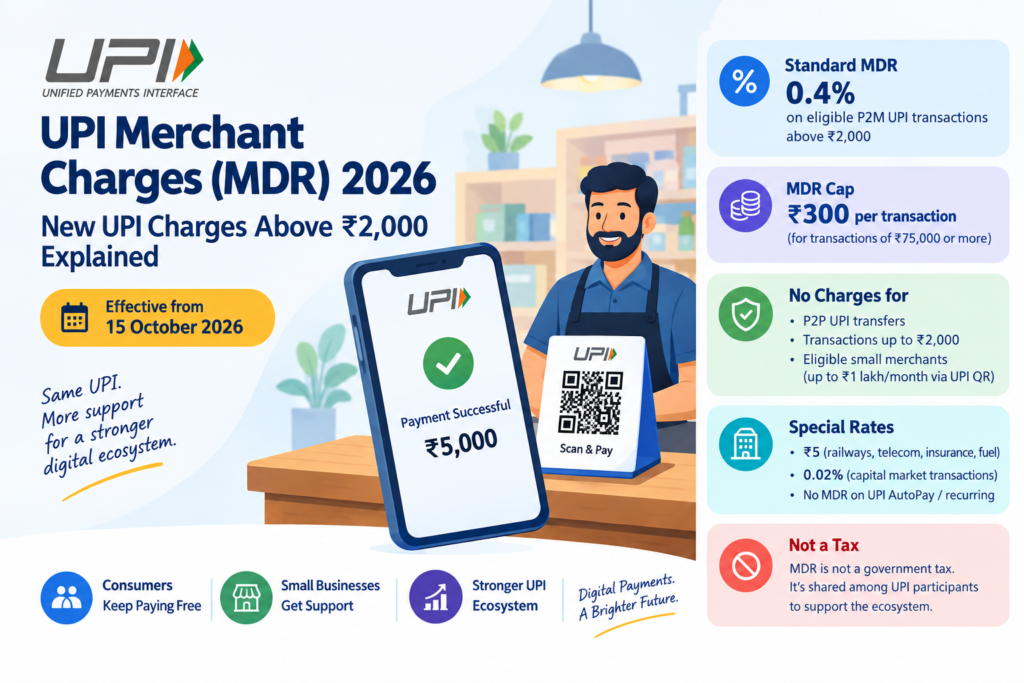
UPI Merchant Charges (MDR) 2026: New UPI Charges Above ₹2,000 Explained
Sep
UPI Merchant Charges (MDR) 2026: New UPI Charges Above ₹2,000 Explained
Unified Payments Interface (UPI) has been one of India’s most widely used digital payment systems. For years, consumers have generally been able to make UPI payments without paying a transaction fee, while merchants have also benefited from the zero-MDR structure for UPI payments.
That is changing for certain merchant transactions.
The National Payments Corporation of India (NPCI) has introduced a revised Merchant Discount Rate (MDR) framework for selected UPI Person-to-Merchant (P2M) transactions. The new framework will take effect from 15 October 2026.
Under the new rules, an MDR of 0.4% will apply to eligible P2M UPI transactions above ₹2,000, subject to a maximum charge of ₹300 per transaction. However, several important exemptions mean that UPI will continue to be free for consumers and for many small-value and small-merchant transactions.
What Is UPI MDR?
MDR stands for Merchant Discount Rate.
It is a fee associated with processing a digital payment received by a merchant. The fee is distributed among participants in the payment ecosystem, such as banks and payment service providers.
The new UPI MDR should not be confused with a government tax.
The Ministry of Finance has clarified that MDR is not a tax collected by the Government or NPCI. Instead, the amount is distributed among participants in the UPI payment ecosystem to support the operation and expansion of the system.
What Are the New UPI Charges From October 15, 2026?
From 15 October 2026, the standard MDR for eligible P2M UPI transactions above ₹2,000 will be:
0.4% of the transaction value
There is also a maximum MDR of:
₹300 per transaction for transactions of ₹75,000 or more.
Examples
| UPI Payment | Standard MDR |
|---|---|
| ₹1,000 | ₹0 |
| ₹2,000 | ₹0 |
| ₹2,500 | ₹10 |
| ₹5,000 | ₹20 |
| ₹10,000 | ₹40 |
| ₹25,000 | ₹100 |
| ₹50,000 | ₹200 |
| ₹75,000 | ₹300 |
| ₹1,00,000 | ₹300 maximum |
These examples apply to an eligible P2M transaction and assume the merchant is not covered by an exemption or special category.
Will Customers Have to Pay the UPI Charge?
No.
The MDR is a merchant-side charge under the new framework. Consumers will continue to be able to make eligible UPI payments without paying the MDR.
The government has specifically stated that UPI will remain free for consumers, while person-to-person transactions will remain outside the MDR framework.
This means that if you purchase something for ₹5,000 from an eligible merchant using UPI, the customer does not pay an additional ₹20 UPI transaction fee.
The merchant is responsible for the applicable MDR.
Are UPI Payments Below ₹2,000 Still Free?
Yes.
P2M UPI payments up to ₹2,000 will remain free of MDR.
According to the government, more than 95% of P2M UPI transactions are below the ₹2,000 threshold. As a result, approximately 96% of merchant transactions are expected to remain unaffected by the new framework.
For example:
- ₹500 UPI payment → No MDR
- ₹1,000 UPI payment → No MDR
- ₹1,500 UPI payment → No MDR
- ₹2,000 UPI payment → No MDR
The new standard MDR starts only for eligible P2M payments above ₹2,000.
Are Person-to-Person UPI Transfers Charged?
No.
Person-to-person (P2P) UPI transactions remain free regardless of the amount transferred.
For example, sending ₹5,000 from your UPI account to a family member’s bank account does not attract the new merchant MDR.
The new charge is focused on selected person-to-merchant (P2M) transactions rather than ordinary transfers between individuals.
What About Small Merchants?
Small merchants receive special protection under the new framework.
Merchants classified under the Person-to-Person-Merchant (P2PM) category and receiving up to ₹1 lakh per month through UPI QR codes directly into their bank accounts can continue to receive UPI payments without MDR.
This is particularly relevant for businesses such as:
- Street vendors
- Small shops
- Local retailers
- Small service providers
- Other micro businesses
Importantly, an eligible small merchant can receive a payment above ₹2,000 without automatically becoming liable for the standard 0.4% MDR if the merchant remains within the applicable P2PM exemption.
What Happens If a Small Merchant Receives More Than ₹2,000?
The ₹2,000 transaction threshold should not be viewed in isolation.
For an eligible P2PM small merchant, the zero-MDR exemption can continue even when an individual payment exceeds ₹2,000.
For example, if an eligible small merchant receives ₹5,000 through UPI and remains within the applicable ₹1 lakh monthly P2PM limit, the payment can remain exempt from MDR.
Therefore, merchants should check their merchant category and monthly UPI collections, rather than assuming that every payment above ₹2,000 will automatically incur a charge.
What Is the ₹300 UPI MDR Cap?
For eligible standard P2M transactions of ₹75,000 or more, MDR is capped at ₹300 per transaction.
For example, at 0.4%:
- ₹75,000 × 0.4% = ₹300
- ₹80,000 × 0.4% = ₹320, but the cap limits the MDR to ₹300
- ₹1,00,000 × 0.4% = ₹400, but the cap limits the MDR to ₹300
The cap therefore becomes particularly relevant for higher-value merchant transactions.
Are There Special UPI MDR Rates for Some Industries?
Yes.
Certain merchant categories receive a special flat-rate treatment instead of the standard 0.4% MDR.
The framework provides a ₹5 MDR for transactions above ₹2,000 in specified categories including:
- Railways
- Telecom services
- Insurance
- Fuel
For example, a qualifying fuel transaction above ₹2,000 would attract the applicable ₹5 MDR rather than 0.4% of the transaction value.
This means a ₹10,000 qualifying transaction in one of these categories would not result in a ₹40 MDR under the standard 0.4% calculation.
What About Stockbrokers and Capital Market Payments?
The new framework also provides special treatment for certain capital-market-related transactions.
Payments involving categories such as mutual funds, stockbrokers, dealers and securities firms can attract an MDR of 0.02%, with a maximum cap of ₹300 per transaction.
The exact treatment depends on the merchant category and transaction classification.
Does UPI MDR Apply to UPI AutoPay?
The prescribed MDR framework does not apply to certain UPI Mandates/AutoPay recurring transactions.
This includes recurring payments such as qualifying utility payments, OTT subscriptions and recurring investments.
Therefore, users should distinguish between a normal merchant UPI payment and an eligible recurring UPI mandate.
Does UPI MDR Apply to RuPay Debit Card Transactions?
RuPay debit card transactions remain outside the new MDR framework.
The government’s explanation of the new framework specifically states that RuPay debit card transactions remain free under the applicable zero-MDR provisions.
However, merchants should distinguish RuPay debit card transactions from other payment instruments and check the applicable rules for their specific payment setup.
Why Is UPI MDR Being Introduced?
UPI has grown into a very large digital payment infrastructure, requiring significant investment in:
- Payment infrastructure
- Cybersecurity
- Reliability
- Fraud prevention
- Technical systems
- Customer support
- Merchant onboarding
- Innovation
According to the NPCI FAQ, the MDR collected under the new framework will remain within the UPI ecosystem and help support these activities.
The government has also proposed a dedicated fund to support UPI adoption and merchant infrastructure, particularly for smaller merchants and underserved regions.
Will UPI Become Expensive for Consumers?
For consumers, the key point is that the new MDR is not a consumer transaction fee.
The revised framework keeps:
- P2P UPI transactions free
- P2M transactions up to ₹2,000 free
- Eligible small-merchant P2PM transactions free
- Consumers free from the MDR itself
The government estimates that approximately 96% of merchant transactions will remain unaffected.
What Does the New UPI MDR Mean for Businesses?
The impact will depend on the business’s transaction size and merchant classification.
A business receiving mostly small UPI payments may see little or no impact because payments up to ₹2,000 remain exempt.
Businesses regularly receiving larger P2M payments, however, may need to account for MDR in their payment-processing costs from October 15, 2026.
For example, a business receiving 100 eligible UPI payments of ₹10,000 each would have gross MDR of:
100 × ₹40 = ₹4,000
before considering any applicable category-specific rules or exemptions.
Businesses should therefore review their UPI merchant account classification and payment-processing agreement before the new framework becomes effective.
Can Merchants Add the MDR to the Customer’s Bill?
The MDR is intended as a merchant-side payment-processing cost.
Banks have been advised to ensure merchants do not pass the MDR on to customers as an additional UPI charge. Consumers should therefore not be asked to pay an extra UPI fee simply because they chose UPI as their payment method.
UPI Charges vs Credit Card Charges
The new UPI MDR is considerably lower than typical merchant fees associated with many traditional card transactions.
NPCI’s FAQ compares the baseline UPI MDR of 0.4% with typical credit-card MDRs in the range of 1.5% to 2.5% and debit-card MDRs that can be higher than UPI’s new rate depending on the applicable framework.
This comparison is useful for businesses deciding which payment methods to offer customers.
UPI MDR 2026: Quick Summary
| Feature | New UPI Framework |
|---|---|
| Effective date | 15 October 2026 |
| P2P UPI | Free |
| P2M up to ₹2,000 | Free |
| Standard P2M above ₹2,000 | 0.4% MDR |
| MDR cap | ₹300 per transaction |
| Cap applies from | ₹75,000 |
| Small P2PM merchants | Zero MDR under applicable ₹1 lakh monthly limit |
| Selected rail/telecom/insurance/fuel categories | ₹5 above ₹2,000 |
| Capital-market categories | 0.02%, subject to applicable cap |
| Consumer MDR | No |
| UPI AutoPay/eligible recurring mandates | No prescribed MDR |
Frequently Asked Questions
Is UPI completely free from October 2026?
Not for every merchant transaction. P2P payments and many small-value transactions remain free, while eligible P2M transactions above ₹2,000 can attract MDR from 15 October 2026.
Is there a UPI charge on ₹2,000?
No. Eligible P2M transactions of ₹2,000 or less remain free of MDR.
What is the new UPI MDR rate?
The standard MDR for eligible P2M UPI transactions above ₹2,000 is 0.4%, subject to a maximum of ₹300 per transaction.
Who pays UPI MDR?
The MDR applies on the merchant side for eligible transactions. It is not a fee charged directly to consumers.
Will sending ₹10,000 to another person through UPI cost money?
No. Person-to-person UPI transfers remain free regardless of the amount.
Will a small shop have to pay MDR on a ₹5,000 UPI payment?
Not necessarily. Eligible P2PM small merchants receiving up to ₹1 lakh per month through UPI QR can remain under the zero-MDR framework.
When do the new UPI charges start?
The revised framework takes effect on 15 October 2026.
Is UPI MDR a government tax?
No. The Ministry of Finance has clarified that MDR is not a government tax. It is distributed among participants in the payment ecosystem.
Final Takeaway
The new UPI MDR framework does not mean that consumers will suddenly have to pay a UPI fee for every payment.
From 15 October 2026, the major change is that selected P2M UPI transactions above ₹2,000 will attract a merchant-side MDR of 0.4%, capped at ₹300 per transaction. At the same time, P2P payments, payments up to ₹2,000 and eligible small merchants remain protected by zero-MDR provisions.
For businesses, the most important steps are to check their UPI merchant category, monthly UPI collections and payment-service-provider terms before the new framework takes effect.
For consumers, everyday low-value UPI payments and person-to-person transfers remain free under the new rules.
